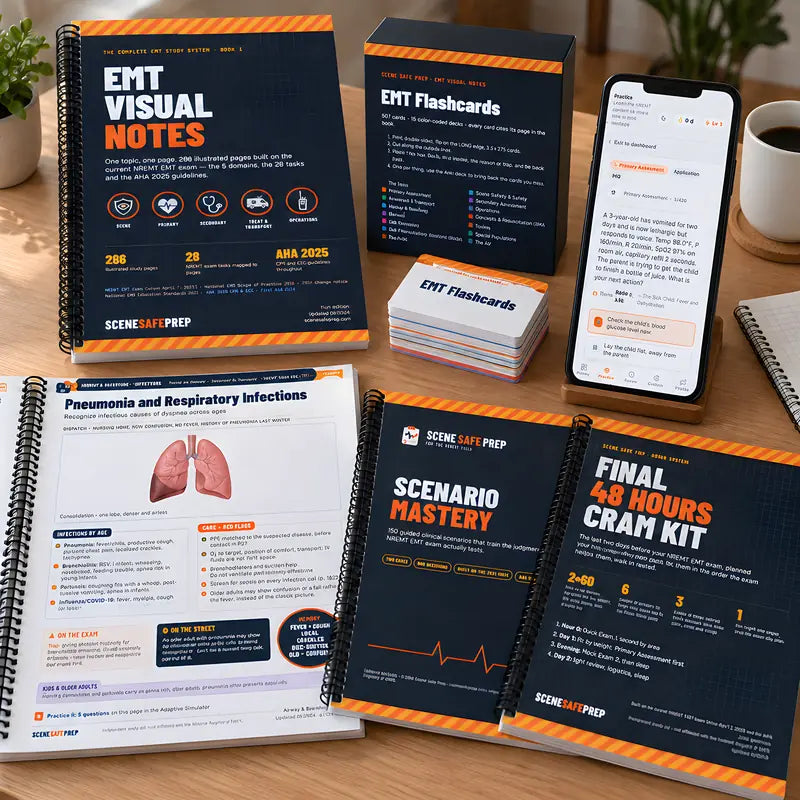
The EMT prep built for today's NREMT.
286 illustrated pages (302 in all), a 1,557-question adaptive simulator and 6 more tools. Every question sends you to the page that teaches it.

Miss a question.Land on the page that fixes it.
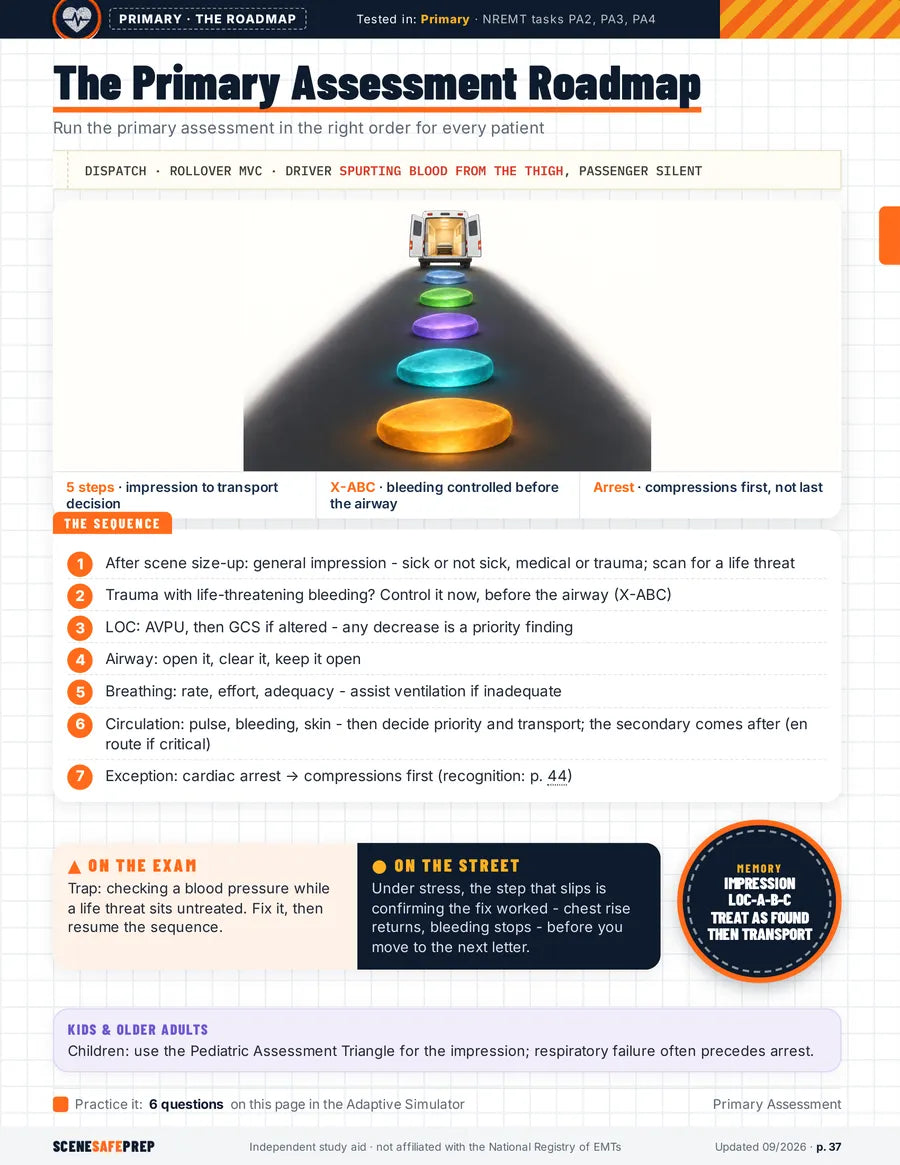
Blood spurts from a groin wound. Which 2 actions come before the airway?
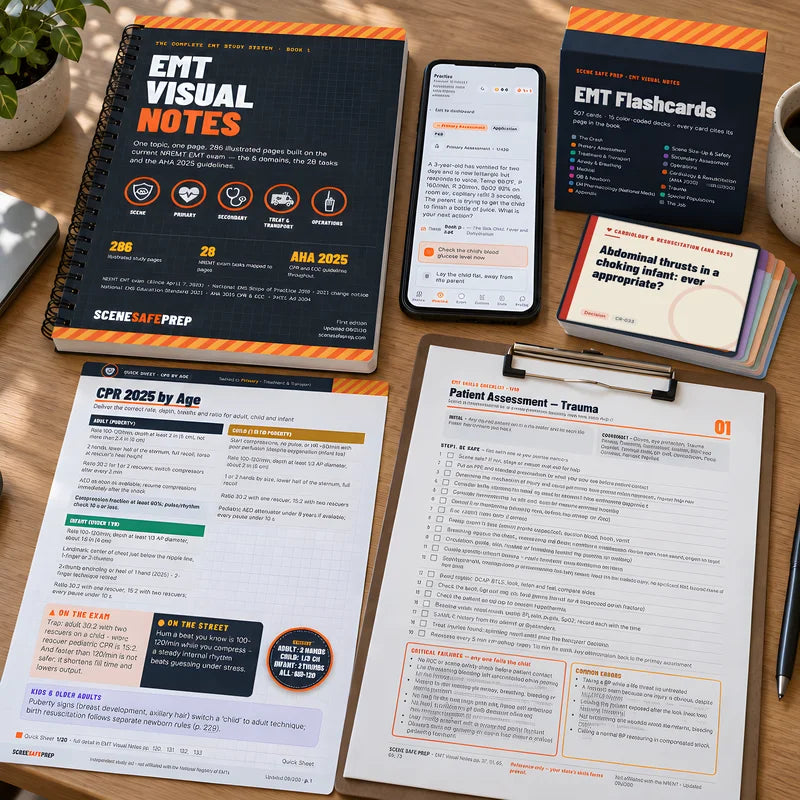
Pass Pack · everything below, in one package
Shown printed: you get the print-ready PDF (plus phone version).
Pass Pack
The EMT Study System, built on the April 2025 NREMT blueprint.
Upgrade later: pay only the difference (within 7 days).
Try 3 real questions.
Straight from the simulator, in 3 of the NREMT's 5 formats. Answer, see why, then open the page that teaches it.
One NREMT attempt costs $104. The Complete System: $59 once.
✓ 14-day money-back guarantee · Instant download
On April 7, 2025 the NREMT EMT exam changed. A lot of study guides didn't.
- Chapters by body system5 phases of the call, weighted like the test
- Multiple choice only5 item types, all-or-nothing
- Fixed-length practice testsAdaptive: 70 to 120 items, stops at 95% certainty
- 2020 CPR and choking stepsAHA 2025, flagged where it changed
The 5 exam domains
What's in each package
Every tool is also sold on its own, so the savings are real, not a made-up "original price".
| Tool | Notes$39 | Complete$59 | Pass Pack$69 |
|---|---|---|---|
| EMT Visual Notes · 302 pages ($39) | ✓ | ✓ | ✓ |
| Adaptive Simulator · 1,557 questions ($39) | – | ✓ | ✓ |
| 507 Flashcards ($19) | – | ✓ | ✓ |
| 20 Quick Sheets ($14) | – | ✓ | ✓ |
| 10 Skills Checklists ($12) | – | ✓ | ✓ |
| Study & Retake Plan | – | ✓ | ✓ |
| Scenario Mastery ($24)150 full calls: the "what first, what next" judgment the exam weighs most | – | – | ✓ |
| Final 48 Hours Cram Kit ($19)Hour-by-hour plan, must-know numbers, 2 final timed runs | – | – | ✓ |
| Simulator access codes | 0 | 1 | 1 |
| Bought separately | $39 | $123 | $166 |
See the full table of contents286 topics in 15 chapters
01Part I · The Exam12 pages
- The NREMT EMT Exam at a Glance
- How the Adaptive Exam Decides
- Scores, Results and Retakes
- The 5 Domains and Their Weights
- The 28 Tasks Mapped to This Book
- Multiple Choice and Multiple Response
- Options Table, Build List, Drag-and-Drop
- Best-Answer Reasoning
- How NREMT Items Are Written
- Pediatrics, Scope and AHA 2025
- Your Study Plan on One Page
- Part I Review
02Scene Size-Up & Safety16 pages
- Scene Size-Up & Safety
- Dispatch and the Pre-Arrival Plan
- Arrival: Positioning and Approach
- Roadway and Vehicle Hazards
- Violence and Crime Scenes
- Environmental and Rescue Hazards
- Invisible Hazards: When to Back Out
- Standard & Transmission Precautions
- Choosing and Wearing PPE
- Mechanism of Injury: Vehicle Crashes
- Falls, Penetrating, Blast; Illness Clues
- Finding Every Patient
- Multiple Patients: From Size-Up to Triage
- Requesting Resources: Who, When, How
- Size-Up Sequence Drill
- Scene Size-Up Review
03Primary Assessment28 pages
- Primary Assessment
- The Primary Assessment Roadmap
- Establishing Rapport
- Rapport Across the Life Span
- General Impression: Sick or Not Sick
- Pediatric Assessment Triangle
- LOC: AVPU and Orientation
- Glasgow Coma Scale
- Unresponsive: Recognizing Arrest
- Assessing the Airway
- Assessing Breathing: Adequate or Not
- Hypoxia and Hypoventilation
- Respiratory Distress, Failure, Arrest
- Assessing Circulation
- Shock: Compensated to Decompensated
- Primary Assessment in Trauma
- Life Threats: Treat as You Find
- Chief Complaint and Choosing the Path
- Rapid Transport: The Priority Decision
- Calling for More: ALS and Rapid Treatment
- Vital Signs: The Baseline Set
- Blood Pressure
- Pupils and Skin Signs
- Pulse Oximetry
- Blood Glucose Monitoring
- 12-Lead ECG: Acquire and Transmit
- Temperature and Other Monitoring
- Primary Assessment Review
04Secondary Assessment12 pages
- Secondary Assessment
- Which Exam, When
- SAMPLE History
- OPQRST and Pain Scales
- Interview Tactics and Pertinent Negatives
- DCAP-BTLS and the Full-Body Exam
- Head, Neck and Chest Findings
- Abdomen, Pelvis, Extremities and Back
- Focused Exam by Body System
- Reassessment
- Trends and Checking Your Interventions
- Secondary Assessment Review
05Treatment & Transport15 pages
- Treatment & Transport
- Airway & Breathing: The Ladder
- Managing Circulation: The EMT Toolkit
- Spinal Motion Restriction: Who Needs It
- SMR in Practice: Collars & Transfers
- Medications by Chief Complaint
- Adapting Care for Size and Age
- Where to Go: Destination Decisions
- Field Triage 2021: Red Criteria
- Field Triage 2021: Yellow Criteria
- Stroke Destination and Time Windows
- Safe Patient Transport
- Radio Report and Medical Direction
- Handoff at the Hospital
- Treatment & Transport Review
06Operations10 pages
- Operations
- Equipment Readiness and Cleaning
- Medications and Supplies Inventory
- The Patient Care Report
- Documentation Pitfalls and Special Cases
- Stress, Resilience and Grief
- Responder Suicide Prevention and PTSD
- Fatigue, Fitness and Safety Culture
- Exposure and Infection Control
- Operations Review
07Airway & Breathing25 pages
- Airway & Breathing
- Airway Anatomy Across Ages
- Ventilation vs Respiration
- Opening the Airway: Manual Maneuvers
- Suctioning
- Oropharyngeal Airway (OPA)
- Nasopharyngeal Airway (NPA)
- Upper-Airway Obstruction
- Oxygen Delivery Devices
- Oxygen Targets
- Oxygen Cylinders and Safety
- Bag-Valve-Mask Ventilation
- Assisted Ventilation and Special Airways
- CPAP
- Lung Sounds
- Abnormal Breathing Patterns
- Dyspnea: The Differential
- Asthma
- COPD
- Pneumonia and Respiratory Infections
- Pulmonary Embolism
- Acute Pulmonary Edema (Heart Failure)
- Other Causes of Dyspnea
- Advanced Airways: Assist Only
- Airway & Breathing Review
08Cardiology & Resuscitation22 pages
- Cardiology & Resuscitation
- The Heart: Anatomy and Perfusion
- The 2025 Chain of Survival
- Adult BLS Sequence
- High-Quality CPR
- Child CPR
- Infant CPR
- Ventilation During CPR
- Using the AED
- Team CPR, When Not to Start, When to Stop
- Opioid-Associated Emergencies
- Cardiac Arrest in Pregnancy
- Arrest in Special Circumstances
- After ROSC
- Choking: Adults and Children
- Choking: Infants
- Acute Coronary Syndrome: Recognition
- Acute Coronary Syndrome: Management
- Heart Failure & Hypertensive Emergencies
- Aortic Emergencies
- Rhythm Problems & Cardiac Devices
- Cardiology & Resuscitation Review
09Medical Emergencies36 pages
- Medical Emergencies
- Altered Mental Status: The Differential
- Stroke: Recognition and Mimics
- Stroke Scales and LVO Screening
- Stroke: Care and Last Known Well
- Seizures and Status Epilepticus
- Syncope
- Headache and Neurologic Red Flags
- Diabetes: Insulin, Glucose & Tools
- Hypoglycemia: Recognize & Treat
- Hyperglycemia: DKA vs HHS
- Allergic Reaction vs Anaphylaxis
- Anaphylaxis: EMT Management
- Toxicology: Principles & Poison Control
- Toxidromes: Pattern Recognition
- Opioid Overdose: Patient With a Pulse
- Stimulants, Sedatives and Alcohol
- Medication and Household Poisonings
- CO, Cyanide & Inhaled Toxins
- Chest Pain: Not Always the Heart
- Abdominal Pain: Anatomy and Pain Types
- Abdominal Emergencies: Red Flags & Care
- GI Bleeding, Vomiting and Dehydration
- Renal Emergencies and Dialysis Patients
- Genitourinary and Gynecologic Emergencies
- Sexual Assault: Care and Evidence
- Hematologic Emergencies
- Behavioral Emergencies: Medical Mimics
- Anxiety, Depression and Psychosis
- Suicide Risk and Self-Harm in Patients
- Agitation, De-escalation & Restraint
- Infectious Diseases EMTs Meet
- High-Consequence and Outbreak Infections
- Sepsis
- Weak, Dizzy and Vague Complaints
- Medical Review
10Trauma34 pages
- Trauma
- Bleeding: Types and Recognition
- External Hemorrhage Control Sequence
- Tourniquets
- Wound Packing and Hemostatic Dressings
- Shock: Types and Causes
- Shock: EMT Management
- Soft-Tissue Injuries and Dressings
- Special Wounds
- Burns: Depth and Extent
- Burns: EMT Care and Burn-Center Criteria
- Chemical, Electrical and Radiation Burns
- Chest Wall Injuries
- Pneumothorax and Hemothorax
- Heart and Great-Vessel Injuries
- Abdominal and Pelvic Trauma
- Head Injury: Recognition
- Head Injury: Management
- Face and Neck Injuries
- Eye and Dental Injuries
- Spinal Cord Injury: Recognition
- Seated Patients, Helmets & Extrication
- Musculoskeletal: Types & Signs
- Splinting Principles
- Traction Splint
- Upper-Extremity Injuries
- Lower-Extremity and Hip Injuries
- Heat Illness
- Cold Emergencies
- Drowning and Diving Emergencies
- Bites, Stings and Envenomation
- Lightning and Altitude
- Multisystem Trauma: Putting It Together
- Trauma Review
11OB & Newborn12 pages
- OB & Newborn
- Pregnancy: Anatomy and Normal Changes
- Bleeding in Pregnancy: Early vs Late
- Trauma in Pregnancy
- Hypertensive Disorders of Pregnancy
- Labor and the Imminent Delivery Decision
- Normal Delivery
- Delivery Complications
- Postpartum Hemorrhage and Other Risks
- The Newborn: First Minutes and APGAR
- Newborn Resuscitation (2025)
- OB & Newborn Review
12Special Populations15 pages
- Special Populations
- The Aging Body
- Assessing Older Adults and Falls
- Delirium vs Dementia
- Elder Abuse and Neglect
- Child Abuse and Neglect
- Intimate Partner Violence
- Human Trafficking
- Home Airway and Breathing Devices
- Other Medical Devices at Home
- Disabilities and Bariatric Patients
- Cultural Humility and Language Access
- Sudden Infant Death and BRUE
- The Sick Child: Fever and Dehydration
- Special Populations Review
13EMT Pharmacology13 pages
- EMT Pharmacology
- Medication Principles and the Rights
- Routes and the Medication Double-Check
- Oxygen as a Drug
- Oral Glucose
- Aspirin
- Nitroglycerin (Patient's Own)
- Epinephrine Auto-Injector
- Naloxone
- Inhaled Bronchodilators
- Oral OTC Analgesics
- Nerve Agent Antidote Kits
- Pharmacology Review
14The Job19 pages
- The Job
- EMS Systems, Levels and Medical Direction
- Consent and Decision-Making Capacity
- Refusal, Negligence and Abandonment
- Confidentiality and Mandatory Reporting
- Advance Directives and Death in the Field
- Body Mechanics and Lifting
- Moving Patients: Moves & Devices
- Incident Command (NIMS/ICS)
- MCI Triage: The MUCC Standard
- SALT Triage
- START and JumpSTART
- Hazardous Materials
- Terrorism, WMD & Active Threats
- Teamwork and Crew Resource Management
- Vehicle Extrication and Rescue
- Air Medical Transport
- EMS and Public Health
- The Job Review
15Appendix17 pages
- CPR 2025 vs 2020: BLS and Choking
- 2025 vs 2020: Beyond BLS
- Normal Vital Signs by Age
- Medical Terminology: Word Parts
- Directional Terms, Planes and Positions
- Body Systems at a Glance
- Perfusion, Metabolism and the ANS
- Medications Patients Take at Home
- Key Numbers Index
- Mnemonics 1: Assessment
- Mnemonics 2: Conditions & Rx
- Mnemonics 3: Operations, MCI and Hazmat
- Abbreviations A-L
- Abbreviations M-Z
- Glossary A-F
- Glossary G-O
- Glossary P-Z
507 flashcards. Each one cites its page.
15 color-coded decks for Anki, Quizlet or print. Front is the cue; back is the answer, the trap and the book page to reread.
Tap a card to flip it
Built to be trusted on exam day.
Every fact comes from the sources your exam is written from, and a real person stands behind it.
100+ sources, citedThe NREMT test plan, the National EMS Scope of Practice, AHA 2025 CPR & ECC and more, listed at the back of the book.
Found an error? We fix itTell us and we correct it and send you the updated file, free.
Free updates for this editionWhen the NREMT swaps its 2020 CPR items for AHA 2025 (expected by January 2027), you get the updated edition.
A real person answersQuestions before you buy? info@scenesafeprep.com, answered by the person who built it.
Questions, answered
Is it updated for the new NREMT (April 2025)?
Which package do I need?
I already failed the NREMT. Will this help?
My exam is soon. Is there enough time?
Is it a printed book? Does it work on my phone?
How is this different from a question app?
How fast do I get it?
What if it's not for me?